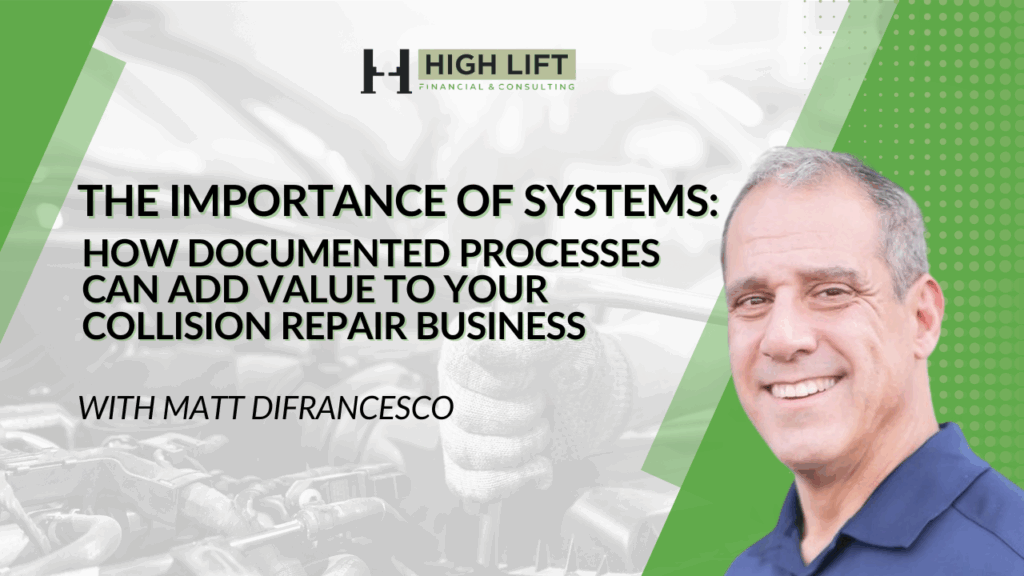
In the fast-paced world of collision repair, shop owners juggle countless responsibilities—managing technicians, ensuring quality control, dealing with insurance companies, and keeping customers satisfied. For many, the day-to-day demands can feel overwhelming, and without standardized systems in place, the shop often runs on the sheer willpower of the owner.
But what happens when the owner wants to step back—or even sell the business? That’s where documented processes and standardized systems become a true game-changer. They not only streamline operations but also directly increase the value of the business by reducing dependence on any single person. For potential buyers, that makes your collision repair business far more attractive.
Let’s break down why documented systems matter and how they add measurable value to your shop.
If you plan to sell your business soon and need an exit strategy, schedule a free 20-minute conversation with Matt DiFrancesco. Discuss your vision and find out how you can adjust the nuts and bolts of your business and life to become prosperous.
Why Systems Matter in Collision Repair
For many collision shop owners, the focus is naturally on daily operations: quality repairs, Every collision shop has a way of doing things. But in many cases, those “ways” are informal, passed down verbally or learned through trial and error. Without documentation, procedures vary from person to person—and that inconsistency can create inefficiency, mistakes, and rework.
Documented systems, on the other hand, provide structure. Whether it’s estimating, ordering parts, handling supplements, or final quality checks, having written and standardized procedures ensures that everyone follows the same playbook. This reduces errors, saves time, and helps deliver consistent results for customers.
Consistency is the foundation of a scalable business. When your shop operates on systems instead of personalities, it’s no longer dependent on one superstar employee—or even you, the owner.
Reducing Owner Dependence
One of the most significant benefits of documented processes is that they remove the business from being “owner-driven.” Too often, collision repair businesses rely heavily on the owner’s expertise, relationships, and problem-solving ability. This creates what’s known as “key person risk.”
If the business can’t function smoothly without the owner’s daily involvement, its value drops significantly in the eyes of a potential buyer. On the flip side, when processes are clearly documented, employees can handle most day-to-day operations independently. The owner can step back, focus on strategy, or even take time away from the business without everything grinding to a halt.
This shift from “owner-dependent” to “system-dependent” is a major milestone in building a transferable and valuable business.
Attracting Buyers with Standardized Systems
When buyers look at a collision repair business, they’re not just buying equipment, employees, and a brand name. They’re buying the ability for the business to generate consistent, reliable profits in the future.
A shop with documented systems offers exactly that:
– Predictability: Buyers know processes are in place to deliver consistent results.
– Scalability: Systems make it easier to expand to new locations or grow volume without chaos.
– Reduced Risk: With less dependence on the owner, there’s less risk of performance dropping after a sale.
– Training Made Simple: New hires can be onboarded faster when processes are already documented.
To a buyer, strong systems are like insurance that the business will continue to run smoothly after ownership changes hands. That assurance increases the business’s market value.
Practical Areas to Document
Not sure where to begin? Start by documenting the processes that have the biggest impact on efficiency, customer satisfaction, and profitability. Common examples include:
– Estimating & Supplements: Clear guidelines for writing accurate estimates and handling insurance supplements.
– Parts Ordering & Receiving: Step-by-step systems for ordering, verifying, and stocking parts to minimize delays.
– Production Flow: A standardized repair process from teardown to delivery, ensuring nothing falls through the cracks.
– Quality Control: Checklists at key stages to guarantee safety and repair accuracy.
– Customer Communication: Scripts and schedules for updating customers throughout the repair process.
– Employee Onboarding & Training: Manuals or guides that help new technicians and office staff get up to speed quickly.
By documenting even a handful of these processes, you create clarity and reduce the “gray areas” that often slow down work.
Building a Culture Around Systems
While documentation is critical, the true power of systems comes when they’re embraced as part of your shop’s culture. That means training employees on why the systems exist, encouraging feedback to refine them, and holding people accountable to follow them.
Think of systems as living documents. They should evolve as technology changes, as you identify new efficiencies, or as customers’ needs shift. A shop with a culture of continuous improvement is far more appealing to buyers than one that’s stuck doing things “the way we’ve always done them.”
The Long-Term Payoff
Documenting processes takes time and effort upfront, but the long-term payoff is undeniable:
– Reduced stress for the owner—you’re no longer putting out fires all day.
– Improved efficiency and profitability—less rework and fewer delays.
– Higher employee satisfaction—clear expectations make jobs easier and less frustrating.
– Better customer experiences—consistency builds trust and loyalty.
– Increased business value—buyers will pay more for a shop that runs on systems, not personalities.
Ultimately, systems turn your collision repair business into an asset that works for you, rather than a job that consumes you.
Final Thoughts:
If your goal is to create a shop that can thrive without you—and potentially sell at a premium in the future—documented systems are not optional. They are the foundation of a scalable, transferable business.
Buyers don’t just want your equipment, employees, or customer list. They want proof that your business can continue to generate profits consistently, regardless of who owns it. Documented processes provide that proof.
Start small, document one process at a time, and build momentum. Over time, you’ll not only improve daily operations but also position your collision repair business as a valuable, marketable asset.
Are you confident your collision repair business could run smoothly without you at the center of everything?
For many shop owners, the daily grind relies too heavily on their personal involvement, making it tough to take a step back and even harder to attract serious buyers down the road.
That’s where documented systems and processes make all the difference. When your business runs on standardized procedures instead of constant owner oversight, it becomes more efficient, more scalable, and far more valuable.
Don’t wait until you’re ready to sell to start building value. Schedule a free strategy consultation with High Lift Financial today and discover how we can help you prepare your shop—and yourself—for the future you deserve.
Here are other resources related to this topic that you may want to check out:
- The Essential vs. Incidental Owner: Navigating Business Success in Collision Shops
- Transform Your Business: The Perks of Incidental Ownership
- Preparing Your Collision Shop for Sale: Key Steps to Maximize Value
Disclaimer
All information is obtained from sources deemed reliable, but not guaranteed. No tax or legal advice is given nor intended. Content provided herein or on our website should not be construed as an offer for investment advice or for securities, insurance, or other investment products. Investments involve the risk of loss and are not guaranteed. Consult a qualified legal, tax, accounting, or financial professional before implementing any investments or strategy discussed here.
High Lift Financial is a DBA for DiFrancesco Financial Concierge, LLC. Investment advisory services are provided through Cornerstone Planning Group, LLC, an independent advisory firm registered with the Securities and Exchange Commission.