When a collision shop owner starts thinking about an exit, the first question usually revolves around numbers, revenue, EBITDA, multiples, and growth trends.
But seasoned buyers are looking at something deeper.
They are asking, “Where does this shop sit in the market?”
And just as important, “What does this brand mean in the community?”
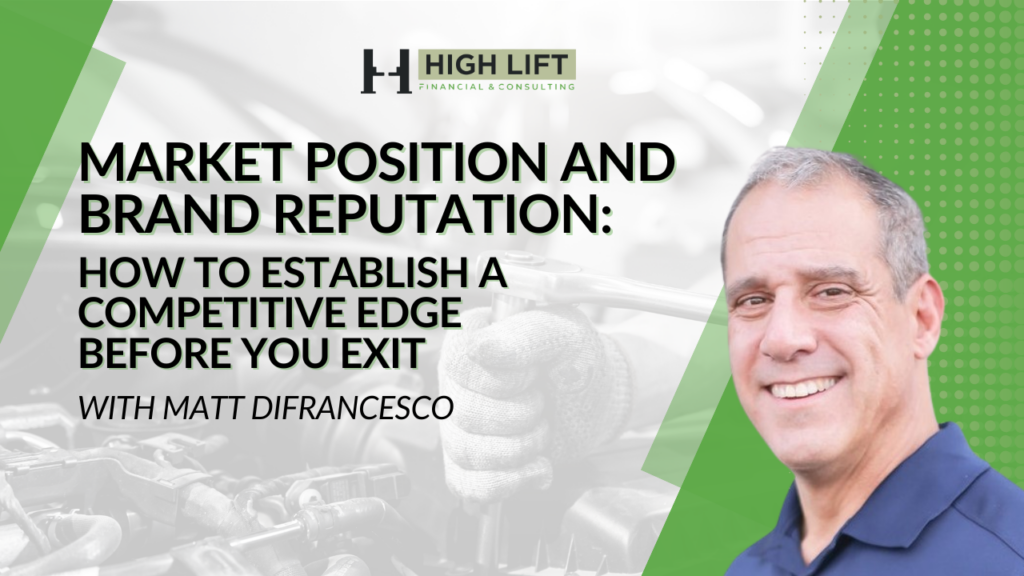
Market position and brand reputation are often the invisible forces behind valuation. They are not line items on a profit and loss statement, yet they influence how a buyer perceives risk, opportunity, and long-term upside. If you want to exit on your terms, you need to shape both well before you ever put the business on the market.
If you plan to sell your business soon and need an exit strategy, schedule a free 20-minute conversation with Matt DiFrancesco. Discuss your vision and find out how you can adjust the nuts and bolts of your business and life to become prosperous.
Your Market Position Is a Strategic Decision
Many shop owners grow organically. They take care of customers, build relationships with DRPs, add equipment when needed, and hire as demand increases. Over time, the business becomes successful through hard work and reputation.
But success alone does not equal strategic positioning.
Market position is about clarity. It answers the question: Why does this shop win?
Is it because you are the most trusted OEM-certified repairer in your region? Is it because you dominate a specific geographic corridor? Is it because you are known for advanced ADAS calibration or luxury vehicle repair? Or is it because you have built a culture that produces consistent cycle times and predictable results?
At the end of the day, buyers are drawn to businesses that make sense. When they can clearly see how you win and why it works, they lean in with confidence. But when the story feels scattered or unclear, they instinctively pull back and start looking for reasons to lower their offer.
If your business looks like every other shop in the market, you become interchangeable. When you are interchangeable, the conversation quickly shifts to price. But when your shop occupies a defined space in the market, you are no longer just another option. You become strategic.
That strategic positioning reduces perceived risk. And when risk goes down, value goes up.
Brand Reputation Is More Than Reviews
Brand reputation is not your logo. It is not your color scheme. It is not even your marketing.
It is what people say about your business when you are not in the room.
In the collision industry, reputation travels fast. Insurance partners talk. Vendors talk. Technicians talk. Customers share experiences. Your name either carries weight or it does not.
Before an exit, reputation becomes a magnifying glass. Buyers will speak with industry contacts. They will assess employee morale. They will look at online presence. They will evaluate how stable your relationships appear. They are trying to determine whether the business stands on its own or whether it depends entirely on you.
If your brand is synonymous with professionalism, integrity, and operational excellence, that creates confidence. If your brand is tied solely to your personal involvement, that creates dependency. Dependency is risk. And risk affects value.
One of the most powerful transitions an owner can make is moving from being the brand to building a brand that exists beyond them.
The Shift from Operator to Architect
Many owners build strong businesses through sheer effort. They are the problem solver. The relationship manager. The culture carrier. The rainmaker.
That works for years.
But when exit becomes part of the vision, your role must evolve.
You shift from operator to architect.
As an architect, you begin designing systems that support your market position. You define standards that reinforce your brand. You develop leaders who represent your values. You document processes so consistency becomes part of your identity, not just your personality.
This shift is not about stepping back emotionally. It is about stepping up strategically.
Buyers are not just acquiring equipment and square footage. They are acquiring a platform. A platform that either scales smoothly or requires rebuilding. When your market position is intentional and your brand reputation is reinforced by systems, you are offering a platform.
That is attractive.
Owning Your Narrative Before Someone Else Does
If you do not define your market position, the market will eventually define it for you, and that definition is often shaped by perception rather than intention. You may become known as the shop that handles difficult repairs, the shop that works on everything, or the shop that is simply “good enough,” and while those labels might seem harmless, they carry real weight in how customers, partners, and future buyers view your business.
Establishing a competitive edge before you exit requires you to take ownership of that narrative. It means thinking carefully about how you want your business to be described five years from now and then aligning today’s decisions with that future identity. Your investments should reinforce that positioning, your hires should strengthen it, and your partnerships should support and amplify it.
Brand reputation is not built through grand gestures but through small, consistent moments that accumulate over time. It is shaped by the way estimates are communicated, the way supplements are handled, the way employees are treated, and the way conflict is resolved.
Collectively, these daily interactions form a story about who you are as a business. When buyers conduct their diligence, they are reading that story closely, so it is essential that it reflects something you intentionally created rather than something that developed by default.
Exit on Your Terms
When the time comes to exit, you want buyers competing for the opportunity, not negotiating from skepticism.
A clearly defined market position tells buyers exactly where you win. A strong brand reputation assures them that what you built will endure.
Together, they form a competitive edge that cannot be replicated overnight.
Your exit will always involve financial considerations. But it will also involve perception. And perception is shaped long before a letter of intent ever arrives.
The owners who exit on their terms are rarely the ones who focused only on the numbers. They are the ones who understood that value is built at the intersection of performance, positioning, and reputation.
Build with the end in mind. Not because you are ready to leave tomorrow. But because the strongest exits are created years before they happen.
Are you running a collision shop but rarely stepping back to think about how your market position and brand reputation are shaping your future exit?
Most owners focus on production, profitability, and keeping customers happy. Those things matter. But long before a buyer looks at your financials, they are forming an opinion about where your shop sits in the market and what your name represents.
Your market position answers a simple but powerful question: why do you win?
Your brand reputation answers another: what does your name mean when you are not in the room?
At High Lift Financial, we help collision shop owners strengthen both. Establishing a competitive edge before you exit is not about last-minute improvements. It is about intentionally shaping how your business is perceived, building leadership and systems that reinforce that perception, and creating a company that stands on its own. When your market position is clear, and your brand reputation is strong, buyers see stability, opportunity, and long-term upside.
If exiting on your terms is the goal, the groundwork begins today. Schedule a free strategy consultation with High Lift Financial, and let’s position your business so its market presence and reputation translate into meaningful leverage when the time is right.
Here are other resources related to this topic that you may want to check out:
- The Essential vs. Incidental Owner: Navigating Business Success in Collision Shops
- Transform Your Business: The Perks of Incidental Ownership
- Financial Health Check-Up For Shop Owners Before Exit
Disclaimer
All information is obtained from sources deemed reliable, but not guaranteed. No tax or legal advice is given nor intended. Content provided herein or on our website should not be construed as an offer for investment advice or for securities, insurance, or other investment products. Investments involve the risk of loss and are not guaranteed. Consult a qualified legal, tax, accounting, or financial professional before implementing any investments or strategies discussed here.
High Lift Financial is a DBA for DiFrancesco Financial Concierge, LLC. Investment advisory services are provided through Cornerstone Planning Group, LLC, an independent advisory firm registered with the Securities and Exchange Commission.